
Home/Services/3D product visualisation
3D product visualisation and WebGL development
Real-time 3D in the browser, with no plugin and no app install — so a customer on a phone can turn your product over in their hand before they buy it.
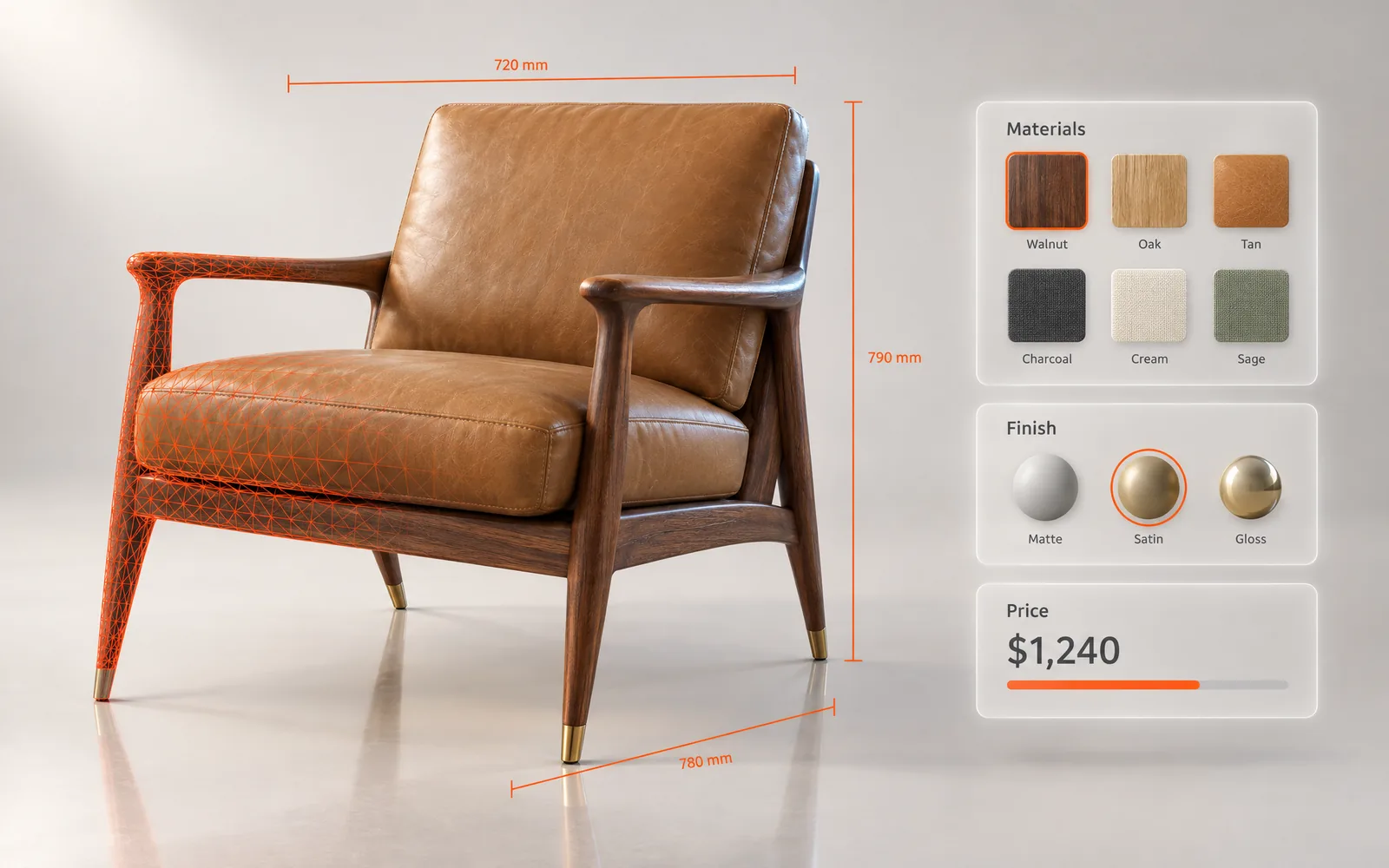
Built for products, not for demos
A 3D product viewer has a different job from a game or an architectural walkthrough. It has to load in seconds on a mid-range phone, show the material honestly enough that a customer trusts it, and stay accurate to the options they selected. Looking impressive is not sufficient; looking correct is the requirement.
- Parametric geometry. Models generated from the configuration rather than a folder of pre-made files, so a new size or option does not mean a new 3D asset.
- Custom shaders. Hand-written GLSL where off-the-shelf materials cannot reproduce a finish — stone, brushed metal, woven fabric, etched surfaces.
- Physically-based materials. Correct roughness, metalness and environment lighting, so a polished surface looks polished and a matt one does not.
- Performance budgets. Draw-call and texture budgets set at the start and held to, because a viewer that stutters costs you the sale.
- AR-ready output. GLB and USDZ, so the product can be placed in a real room from a phone.
When 3D is worth it — and when it isn't
3D is worth the money when depth, finish or assembly genuinely change the buying decision: furniture, fabricated metal, stone, packaging, signage, anything with a visible material. It is usually not worth it for flat printed goods, where a crisp 2D preview is faster to build, faster to load and just as persuasive.
We will tell you which of those you are before quoting, not after.
Common questions
Which 3D library do you use?
Three.js for almost everything, with hand-written GLSL shaders where the standard materials cannot reproduce a finish. React Three Fiber where the surrounding application is React and the component model helps.
Will it work on mobile?
Yes, and mobile is where it gets tested first. Performance budgets are set at the start of the build and held to, because most product browsing happens on a phone.
Can you match our actual product materials?
Yes — that is what the custom shader work is for. Send physical samples or reference photography and the materials are tuned against them rather than guessed.
Can we get AR as well?
GLB and USDZ export covers AR on both Android and iOS. It is a reasonable addition once the 3D model is already parametric.
Tell me what your customers should be able to design.
If your process today is an email, a sketch, and somebody rebuilding it by hand afterwards — that's the problem I work on.
or email [email protected]